Use the grammar that fits the system
Start with a concept map, or use flowcharts, C4, sequence diagrams, entity relationships, and five more text-first diagram families.
Text-first diagrams and connected technical knowledge
Sestina turns text into live diagrams you can edit together and save as named revisions. Connect them to the domain language, ADRs, and technical guidance that explain how the system works—and why.
For technical leaders ↓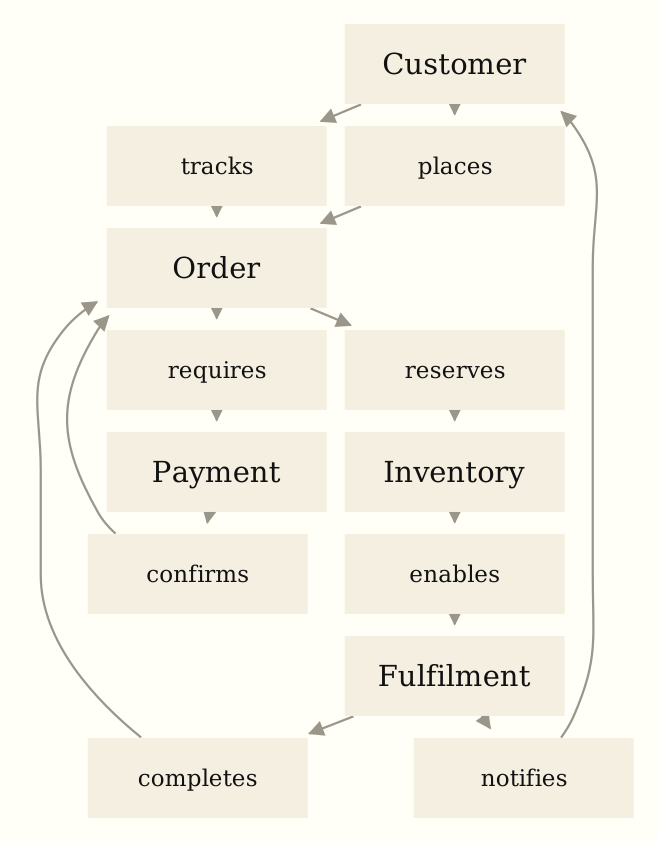
Available now
Describe relationships instead of arranging boxes and arrows. Sestina keeps the readable source authoritative and derives the view from it, so structure remains easy to review, revise, and share.
Start with a concept map, or use flowcharts, C4, sequence diagrams, entity relationships, and five more text-first diagram families.
Work in the same source at the same time. Cursors, selections, and the rendered view keep collaborators oriented as the model changes.
Save a named revision when the model says something worth preserving, then compare it with what came before.
The concepts in a map become terms your team can define, relate, find, and reuse across the workspace.
A diagram makes one pattern visible. The language, decisions, and explanations around it are part of the system too.
Personal · Forthcoming
The diagram shows that Payment confirms an Order. The decision record explains why inventory is reserved afterwards, what alternatives were rejected, and when that reasoning should be reconsidered.
An Order reserves Inventory only after Payment is confirmed. This avoids holding stock for abandoned checkouts while keeping Fulfilment downstream of a decision the business can explain and revise.
Write ADRs and technical guidance in the same text-first workspace. Edit together, preserve named revisions, and connect each document to the terms and views that give it meaning.
Personal adds unlimited diagrams, connected documents and ADRs, multiple bounded contexts, language health, artifact-specific access, and Personal Git Sync.
Understanding is distributed across people, language, diagrams, decisions, and code. Sestina keeps those partial views in relation, so the reason behind a design can survive a handoff and a difference in language can become a useful discussion instead of hidden ambiguity.
Ordering — places an
Payments — is responsible for a
Fulfilment — receives a
“Customer” recurs across the system, but it does not mean precisely the same thing everywhere. Preserve each bounded meaning, show where they meet, and build coherence without flattening useful differences.
Knowledge survives handoffs. Differences become discussable. Decisions keep the context that made them sound.
Current proof → Enterprise direction
The most useful context for AI begins as leverage for human judgement: explicit relationships, precise language, accepted decisions, and visible provenance. Sestina is building the governed layer that keeps that context reviewable as people and systems change.
Authenticated, read-only MCP access can list maps, search concepts and relationships, and find paths through the model.
Extend that foundation with document retrieval, agent proposals and co-authoring under review, identity and provenance controls, Git-primary workflows, organisation administration, SSO, and audit.
Read the thinking
A field-notes series on text-first diagrams, shared technical language, and the decisions that hold a system together. Written in the open while we build the product.
You do not have to model the whole company. Put one relationship into words. Let the larger pattern become visible as terms, decisions, and contexts accumulate.